Tuesday 26 June 2007

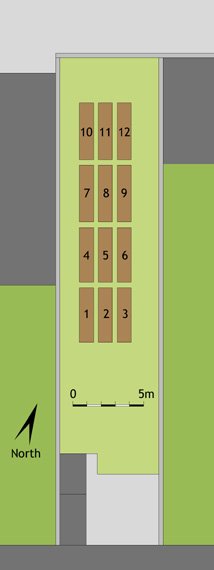
Week 26 - Bed 3 Planting

None of the beans in this bed are doing well, which is not surprising given the cold wet weather that we have had since they were sowed 2 weeks ago. Only a few of the seedlings have emerged, and many of them are looking very poor, or have been eaten. In order to make sure that we get a full crop, we resowed all of the runner beans and three varieties of climbing french beans. We also built a 'tipi' for the french beans and an 'X-frame' for the runner beans using 240cm long bamboo poles and cut up strips of an old rubber inner tube from a bicycle.

Week 26 - Bed 2

This is the healthiest of the courgette plants, the others are still suffering from being transplanted too late (not to mention the bad weather).


Week 26 - Bed 1

The sweetcorn is doing well, we thinned out all but the strongest seedling at each station. This photo also shows one of the courgette seedlings that has come up from a few direct sown seeds that we placed in amongst the sweetcorn.

This is the same squash plant that was photographed in Week 23, and is doing well considering the bad weather and recent transplanting. It really is much better to transplant this family of plants early - or direct seed.


Tuesday 19 June 2007

Week 25 - Overview

We only just got to the garden this week and barely started digging the last of the beds when it started to really rain, so we ended up leaving early. Although the garden needed the watering, it did prevent any planting or photographs.

Tuesday 12 June 2007

Week 24 - Bed 3 Planting

We dug most of this bed this week, using a more thorough lazy-bed method, and sowed:

  • Enorma Runner Bean (2 parallel rows half the length of the bed) - a heavy cropping variety with long smooth, stringless pods and red flowers.
  • Neckargold Climbing French Bean (2 stations) - high yield medium-late variety, with long round yellow beans.
  • Eva Climbing French Bean (3 stations) - an early variety with long oval blue-green pods.
  • Blauhilde Climbing French Bean (3 stations) - maincrop variety with long oval purple pods.
Poles will be added to make a tipi for the climbing french beans and a linear 'X' frame for the runner beans. About a quarter of the bed remains empty.

Tuesday 5 June 2007

Week 23 - Bed 1 Planting

We cultivated this bed this week, using a more thorough lazy-bed method. We had planned to use a no-dig method, but did not get around to doing it early enough in the season to allow the mulch to settle in and start to decompose. Once prepared, we planted:
  • Golden Bantam Sweetcorn (18 stations covering half the bed) - very good variety if harvested in time, with a nice sweet flavour.
  • Ponca Butternut Squash (one 3 week old transplant from pot) - an early winter variety with thick necked fruit and pale carmel skin.
  • Blue Ballet Squash (one 4 weeks old transplant from pot ) - a soft blue-grey skined variety with sweet orange flesh.

A three week old butternut squash plant, just transplanted.

Week 23 - Bed 2 Planting

Four planting stations had been prepared the previous week, mixing in compost, with the rest of the bed remaining un-cultivated, but covered with cardboard (which has been in place for several months. A layer of horse manure was spread over the entire bed and then this was covered with one year old autumn leaves. Into the four prepared stations we transplanted 4 week old plants that had been started in pots:
  • Red Uchiki Kuri Squash - a medium size winter variety with brilliant orange, tear drop shape smooth flesh fruit with sweet nutty taste.
  • Genovese Courgette - a pale, early variety with fine lightly mottled green fruit.
  • Nero di Milano Courgette - a dark green lightly mottled variety.
  • Yellow Straightneck Courgette - an early maturing yellow variety with smooth yellow fruits.
A four week old courgette plant, just transplanted.

Week 23 - Bed 4 Planting

This bed was prepared last week as a lazy bed, and in it we planted:
  • Table Talk Climbing Peas (one long row along edge of bed) - a variety that can grow up to 2 meters tall on good soil, with large full fat pods of tasty sweet peas which can be eaten fresh or dry.
  • Maxi Dwarf French Bean (25% of the bed) - an early variety with medium green pods and good disease resistance.
  • Hildora Dwarf French Bean (25% of the bed) - an early maincrop variety with yellow round oval pods of up to 14cm in length.
  • Saxa Dwarf French Bean (25% of the bed) - an old variety with early light green round pods, suitable for colder climates.
A frame and netting will need to be constructed to support the peas.

Week 23 - Bed 5

Express broad beans eleven weeks after sowing, with early potatoes in the background.

Express broad bean flowers.

Week 23 - Bed 6

Polycrop in bed 6 with peas visible in the bottom left, broad bean to the right of center and potato in the background.