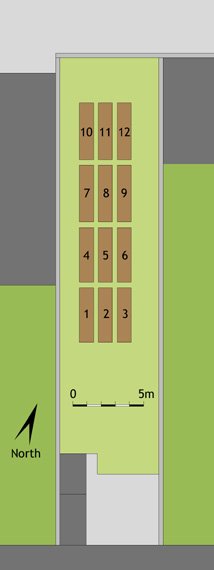
Showing posts with label bed 3. Show all posts

Sunday 21 October 2007

Week 42 - Bed 3

The unseasonably dry and mild weather that we have had for most of October has allowed the plants in this bed to continue to produce, though not as quickly as they would have in the warmth of the summer.

We have not been in the garden for 3 weeks and the few climbing french beans (or pole beans) that grew have produced a number of beans that are now too large to eat the pods. The Blauhilde variety above has beautiful purple pods, which unfortunately turn green when cooked.

The Eva climbing bean variety above produces a wide flat pod. We are going to leave the handful of beans to mature and harvest them as fresh plump seeds which are still tender and have not begun to dry, referred to as either flageolet or shelling beans.

There are quite a number of runner beans, but unfortunately, they too have grown large enough to become tough. We harvested them anyway in hopes that another crop would develop.

One fo the courgette plants has produced a number of reasonable size fruit. The slower growth of the late season has prevented any of them from turning into enormous marrows. The fruit is edible, though not be as tender as those that grow quickly n the heat of the summer.

Sunday 30 September 2007

Week 39 - Bed 3

The frost that hit much of the country this past week did not affect this back garden - one of the benefits of growing food in the city. If it had, everything in this bed would have been killed.

There are very few beans, and we are leaving a few to grow to produce seed.

A fine crop of runner beans for this week.

The Genovese Courgette plant is still small but ...

... each week produces a few small courgettes.

Sunday 23 September 2007

Week 38 - Bed 3 Planting

The runner beans harvest has begun, and we picked a few handfuls of beans today.

The climbing french beans are producing pods, though some have already grown too large to eat. Unfortunately the yield is quite low on each plant (especially in comparison to the runner beans) and only a few plants of each variety survived. We would need at a dozen healthy plants or more to produce enough tender pods for a dinner.

The courgette plant looks healthy ...

... and is still producing a lot of fruit, but they are not growing as quickly as courgettes usually do. This is probably due to the overshadowing by a tree and the lower levels of fertility. We gave this plant a boos of fertility by watering it with diluted tea from a worm bin.

Over the entire bed, under the beans and courgettes we sowed:

  • White Clover - a low lying nitrogen fixing crop that is suitable for undersowing
The clover will grow where there is space and light for the next few months and when the courgettes and beans are killed back by the frosts, the clover will continue to grow slowly throughout the winter. If the weather is reasonable, the clover will fill the bed and can remain until we are ready to sow into the bed next spring, at which time it can be dug in as a composting crop, adding fertility to the soil, including lots of nitrogen.

Sunday 16 September 2007

Week 37 - Bed 3

The beans that survived the first few weeks, have grown past the top of the supports and are now starting to produce - 13 weeks after sowing.

The Eva variety of french bean has produced a number of long oval pods.

A few of the runner beans are large enough to harvest.

The Genovese courgette plant is growing well and starting to produce fruit 10 weeks after direct seeding.

The fruit on the left still has the flower attached and was (hopefully) pollinated yesterday and will be ready to harvest within a week. The one in the middle with the rotten end was not sufficiently pollinated and has been aborted by the plant. The fruit on the right is just right.

The yellow courgette plant is not doing as well.

Tuesday 28 August 2007

Week 35 - Bed 3

The young courgette plant s doing well and the flowers are starting to form.

Tuesday 31 July 2007

Week 31 - bed 3

The runner beans and climbing french beans are starting to climb, though many of the bean plants failed to survive.

A climbing french bean plant starting to spiral up the support.

Two runner bean plant sharing a support cane.

The courgette seedlings are doing well - three plants out of 4 seeds sown. It is time to thin to the strongest plant, which seems to be the one in the foreground.

Saturday 30 June 2007

Week 27 - Bed 3 Planting

In the empty space at the north end of the bed (far end in the photograph below) we planted:

  • Genovese Courgette (4 seeds at one station) - a pale, early variety with fine lightly mottled green fruit
  • Yellow Straightneck Courgette (4 seeds at one station) - an early maturing yellow variety with smooth yellow fruits
These plants will produce later in the season.

Bean seedlings can be seen at the base of some of the bamboo poles.

A healthy climbing french bean seedling, one of only a few.

Tuesday 26 June 2007

Week 26 - Bed 3 Planting

None of the beans in this bed are doing well, which is not surprising given the cold wet weather that we have had since they were sowed 2 weeks ago. Only a few of the seedlings have emerged, and many of them are looking very poor, or have been eaten. In order to make sure that we get a full crop, we resowed all of the runner beans and three varieties of climbing french beans. We also built a 'tipi' for the french beans and an 'X-frame' for the runner beans using 240cm long bamboo poles and cut up strips of an old rubber inner tube from a bicycle.

Tuesday 12 June 2007

Week 24 - Bed 3 Planting

We dug most of this bed this week, using a more thorough lazy-bed method, and sowed:

  • Enorma Runner Bean (2 parallel rows half the length of the bed) - a heavy cropping variety with long smooth, stringless pods and red flowers.
  • Neckargold Climbing French Bean (2 stations) - high yield medium-late variety, with long round yellow beans.
  • Eva Climbing French Bean (3 stations) - an early variety with long oval blue-green pods.
  • Blauhilde Climbing French Bean (3 stations) - maincrop variety with long oval purple pods.
Poles will be added to make a tipi for the climbing french beans and a linear 'X' frame for the runner beans. About a quarter of the bed remains empty.