Showing posts with label bed 8. Show all posts

Sunday 21 October 2007

Week 42 - Bed 8


The area in the foreground has been cleared a circular pattern of all that kale seedlings and loose soil, and a number of hairs were found, identifying this spot the favorite place for a neighborhood cat.

The two sprouting broccoli continue to develop, but have grown in a particular direction, leaning out towards the sun.

The Savoy cabbage (left) and the red cabbage are both starting to firm up, indicating that they could be ready for harvesting, but we will wait a bit longer.

We harvested the largest of the Cour di Bue summer cabbages. Once the outer leaves are pulled off, many of which had suffered slug damage, the inner 'heart' is crisp, bright and delicious raw!

Sunday 30 September 2007

Week 39 - Bed 8


The kale seeds have sprouted, but there is a curious bare circle in the middle of the patch! It looks as though the topsoil and seeds were brushed away, perhaps by a cat playing in the freshly tilled soil.


The centre of each cabbage has a different shape and texture, but each is beautiful, especially the savoy cabbage above with water from an earlier rain shower still caught in the leaf ridges.

Sunday 23 September 2007

Week 38 - Bed 8 Planting

Some of the cabbages in this bed are doing well, but there are a few stunted plants, which could be removed to make space to plant something else - perhaps broad beans. The two sprouting broccoli plants in the foreground have reached a reasonable size. The Ragged Jack Kale seeds that we sowed last week have not sprouted yet. We gave all of the plants a watering with diluted worm tea from the neighbor's worm bin which will help to boost the growth for the rest of the season if the weather remains reasonable.

Underneath all of the cabbage plants we sowed:

  • White Clover - a low lying nitrogen fixing crop that is suitable for undersowing
The clover will grow where there is space and light for the next few months and will survive the winter. As the cabbages are harvested, the clover can remain until we are ready to sow into the bed next spring, at which time it can be dug in as a composting crop, adding fertility to the soil.

The largest of the winter cabbages is only starting to form a head.

The largest of the summer cabbages is firm and is probably ready to harvest. The other two plants are quite a bit smaller (especially the one to the top right of the photo) and will likely not produce anything, and can probably be pulled out when the large one is harvested if we wanted the space to plant something else.

The largest of the red drumhead cabbage plants has formed a small head. the other two plants are farther behind. The dark marks on the leaves are from our hands as we felt the firmness of the cabbage.

The largest of the savoy cabbage plants is looking great with the crinkled leaves, with a small head starting to form.

Sunday 16 September 2007

Week 37 - Bed 8

The transplanted cabbages and sprouting broccoli plants are doing reasonably well, though some better than others. We added a few handfuls of well rotted horse manure around the base of each of the plants to give a fertility boost for the remainder of the season.

Purple Sprouting Broccoli growing well.

The head of the Cour di Bue Cabbage starting to form.

Vertus Savoy Cabbage also starting to form a head which will not be ready until winter.

The head of the Red Drumhead Cabbage is starting to form but it is smaller than expected and will not produce a large cabbage.

Tuesday 4 September 2007

Week 36 - Bed 8 Planting

We prepared a seedbed in the empty area at the south end of the bed and broadcast:

  • Ragged Jack Kale - an old, beautiful variety with purplish stalks, deeply serrated leaves and is very winter hardy
This sowing is an experiment. We have plenty of home saved seed from another garden and are hoping that these will produce numerous small but delicious plants that can be eaten throughout the winter. If not at least it will serve as a cover crop until ready to plant in the spring.

Tuesday 28 August 2007

Week 35 - Bed 8

All of the cabbages in this bed are doing well, though small for this time of year, and there have been no sign of any caterpillars.
Vertus Savoy Cabbage

Red Drumhead Cabbage

Holland Late Winter Cabbage

The Early Purple Sprouting Broccoli plants are also growing well considering the late transplanting.

Tuesday 31 July 2007

Week 31 - Bed 8

The Cabbages are growing well, but the peas have finished producing and died back. They were removed to make room for more transplants of kale plants (not shown) that were left over in the seedbed.

Cour di Bue Summer Cabbage looking healthy but not large enough to start forming a head.

the beautiful colour of the Red Drumhead Cabbage.

Saturday 30 June 2007

Week 27 - Bed 8

A view of this bed from the south showing the peas in the foreground, which have completely outweighed their flimsy supporting sticks, but are still producing, and the newly transplanted cabbage behind. We finally cleared the paths of grass/sod.

The cabbage transplants are doing well, helped by the abundant moisture and lack of scorching sun!
Tuesday 26 June 2007

Week 26 - Bed 8 Planting

We decided to give up on the beetroot and chard, and cleared them from the bed - besides we needed the space for the brassica transplants that are getting too big in Bed 9. We mixed in a few handfuls of dried seaweed fertilizer and transplanted 4 types of cabbages (listed from south to north):

  • Holland Late Winter Cabbage (3 plants) - large, white, solid, hardy variety
  • Cour di Bue Summer Cabbage (3 plants) - large pointed heart variety, maturing in early autumn, light green in colour
  • Red Drumhead (Cabeza) Cabbage (3 plants) - large, solid, ball shaped, deep red variety to harvest from summer to autumn
  • Vertus Savoy Cabbage (3 plants) - medium late variety with round flattish heads, medium green, well curled and frost hardy

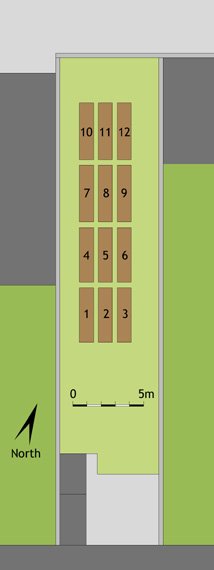
View from the north end of the bed showing the 12 cabbage transplants, with the peas at the south end of the bed.

Week 26 - Bed 8

The peas are starting to produce, but the weight of the plants, helped by the heavy rains, have been too much for the small 'pea sticks' that we had stuck in the ground for the peas to climb up. This has created a mass of pea plants instead of 4 neat rows where all of the peas are easy to see and pick.


The peas are so sweet and tender, a real treat for the gardeners.

The beetroot and chard continue to do poorly, and the rhubarb chard is starting to 'bolt' - produce a seed head - which will further reduce the quality of the leaves. We really failed to provide the right conditions for these plants.

Tuesday 5 June 2007

Week 23 - Bed 8

Meteor dwarf peas eleven weeks after sowing.

Pea pods starting to form.

The variable growth of the beetroot scattered in one section of bed 8, eight weeks after sowing. Many of these beetroot plants seem stunted, and although they need thinning, the plants with plenty of space are not doing any better. The leaves of this variety are normally a much brighter green.

Rhubarb Chard eight weeks after sowing. This is the healthiest plant, the others are not growing well, and several did not even germinate.

Tuesday 22 May 2007

Week 21 - Bed 8

The peas in the foreground are doing well, but the beetroot and chard at the end of the bed are not thriving. This is likely due to a combination of poor fertility of the garden, the lack of water and the warm temperature.

Tuesday 17 April 2007

Week 16 - Bed 8

photo by Eoin Campbell
After four weeks the pea seedlings have grown quite a bit, especially compared to one week ago. Several leaves have formed, and the root system has branched out out quite a bit and has reached almost 20cm long.

Tuesday 10 April 2007

Week 15 - Bed 8 Planting

photo by Eoin Campbell

This bed was prepared a few weeks earlier, with early peas planted at the south end of the bed. This photo is of one of the peas seedlings that we dug up. Only the green leaves and section of the stem was above ground, only 2-3 cm high. The white stem is about 2.5cm long, and below the seed the root stretched almost 15 cm below ground, all of this growth in only 3 weeks, from a dry seed (not pre-soaked or sprouted).

We divided the remainder of the bed into four roughly sections, each about 20% of the bed, and planted beetroot and chards (leaf beat or silverbeet):
  • Swiss Chard - dark green leaves with broad white ribs (also known as silverbeet or leaf beet)
  • Rhubarb Chard - rich ruby-red leaf stalks and dark green/purple foliage
  • Barbietola di Chioggia Beetroot - a mild-flavoured italian, pink skin variety with white flesh and pink rings
  • Storuman Beetroot - fast growing globe beetroot, both summer and main-crop
The chards and the pink beetroot were planted on a equally spaced grid, and the red beetroot were sown by scattering a lot of seeds and covering them with a fine layer of soil.

Sunday 25 March 2007

Week 12 - Bed 8 Planting

This bed had been prepared the previous week as a single-dig bed, and in the south quarter of the bed we sowed:

  • Meteor Dwarf Peas (4 short rows) - an early hardy variety ideal for both autumn and spring sowing, grows to 35cm high
One row of the pea seeds came straight from the packet, while three rows were sown from seed that had been pre-sprouted, a method of ensuring higher germination rates in the cold soil of the spring. Unfortunately the roots of the peas had grown more than they should have, they should have been planted two or three days earlier, and any advantage from the pre-sprouting was probably reduced by the stress on the extended root.
The peas were planted in this bed by mistake - we had planned to plant them into Bed 5 beside the potatoes and broad beans.